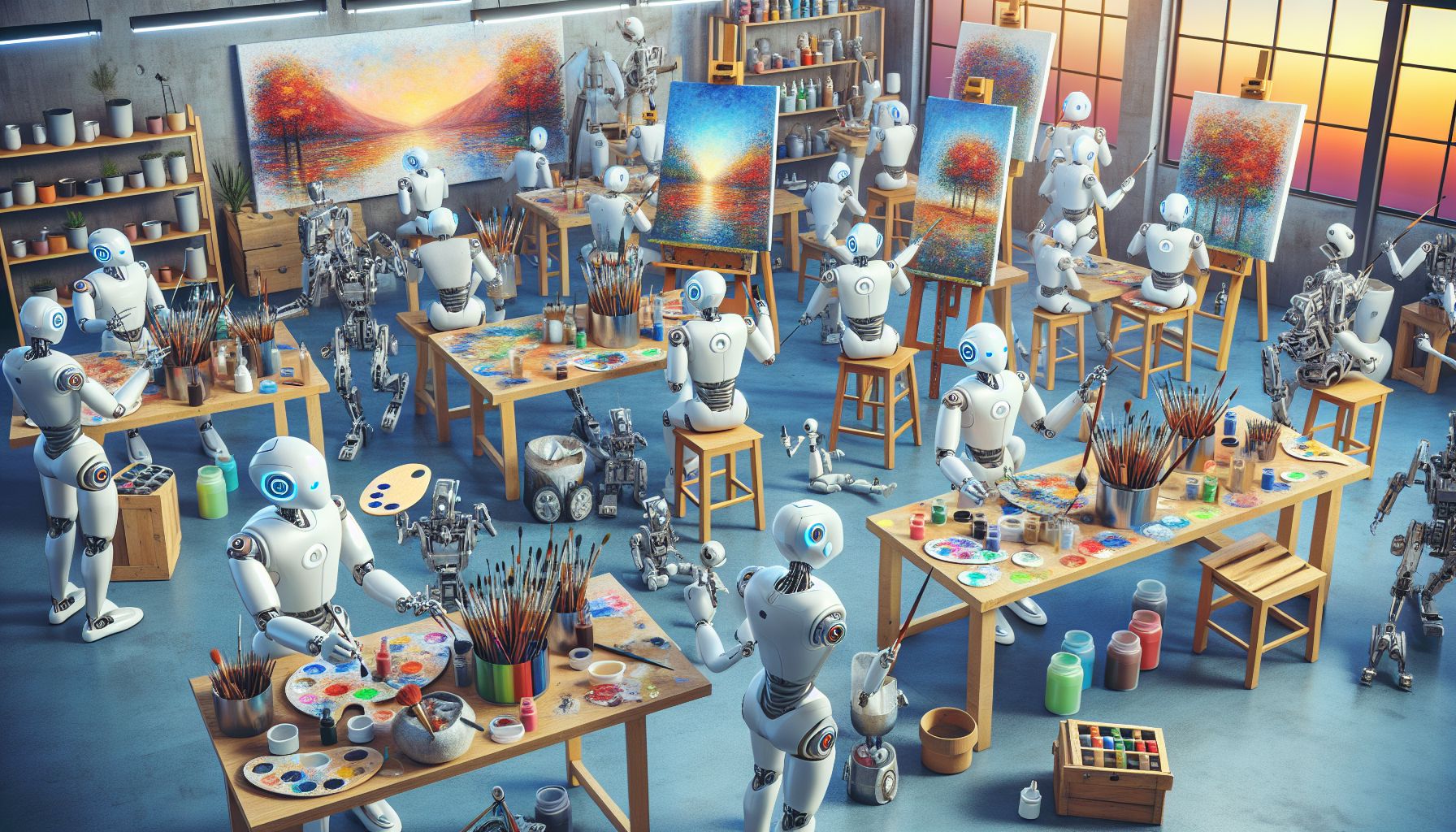
Hey guys and gals, welcome back to my corner of the internet where we dive into all things techy and quirky. Today, I’m buzzing with excitement because we’re dabbling in the world where art meets artificial intellect—or should I say, the merging of oil paints and algorithms. We’re talking about AI in the creative arts!
I know, I know, AI in art sounds like something right out of a sci-fi novel, but trust me, it’s a reality and it’s turning into one heck of an interesting frontier. So, pull up a bean bag, grab your artisanal coffee, and let’s explore this mind-bending journey where pixels meet paints.
Art and Algorithms: A Modern-Day Creative Affair
For centuries, art was the domain of messy studios and paint-splattered aprons, but these days, some of the most interesting “paint-splattering” happens with code. Artificial Intelligence is changing artistic expression, creating pieces that come as much from silicon as they do from graphite and canvas.
But what exactly is AI bringing to the table (or the canvas, as it were)?
Understanding AI in Art
First off, let’s clarify how AI fits into this picture. AI art involves using algorithms to generate, modify, or fully create artworks. These algorithms can “learn” from thousands of existing artworks to replicate styles or even pioneer completely new ones. It’s kind of like when you spend too much time scrolling through #art on Instagram and suddenly you can sketch a passable portrait, but the AI does this at warp speed.
A classic example of AI absolutely nailing the art game is the Portrait of Edmond de Belamy, which you might remember sold for north of $400,000 at Christie’s back in 2018. This piece was created by a clever algorithm and a bunch of historical portraits, proving that algorithms don’t just crunch numbers. They can also create auction-worthy strokes of genius.
When Code Meets Creativity
It’s easy to think of AI as a stoic number-crunching machine, but creative AI is like a computational Da Vinci. When I started messing around with GPT-based tools last year, I fed it a prompt to channel its inner Van Gogh. What popped out was surprisingly moving. Here’s the kicker: it felt like the algorithm was interpreting the art rather than just spitting out computational reproductions.
The reason behind AI’s growing creative abilities comes from machine learning, specifically a type called Generative Adversarial Networks (GANs). Here’s the deal: GANs have two neural networks, one to generate data and the other to critique it. Think of it like an artist being peer-reviewed by their snappy art critic alter-ego. This back-and-forth of creation and criticism leads to art that genuinely grabs you.
The Many Faces of AI Art
Now, let’s break down some of the noteworthy ways that AI is already transforming the art world. From digital canvases to collaborations with human artists, AI doesn’t just change the art game. It expands it into places we’d never thought possible.
The Digital Renaissance
We’re living through what I’ll call a digital renaissance. Whether it’s musicians composing symphonies with AI harmonies, or visual artists creating entire art galleries filled with AI-rendered wonders, digital art isn’t just inclusive. It’s borderless.
Digital artist Refik Anadol uses data-driven algorithms to create immersive installations that blur the line between what’s organic and artificial. By combining data sets with visual art, he creates multisensory experiences that are part art, part tech wonderland.
I tried using AI to create a new “Mona Lisa” with a twist last month, but what came out looked a little more like “Desperately Needs Coffee Lisa.” AI still generates more duds than masterpieces, but when it nails it, it blows the roof off traditional boundaries.
Collaborating with the Carbon-Based Lifeforms
Humans and AI aren’t just parallel players. They’re collaborators. Artists are increasingly using AI tools to broaden their horizons. Take, for example, Google’s DeepDream. Artists use its trippy, psychedelic visuals as a starting point to evolve new artwork.
The key is realizing that AI isn’t a replacement, it’s a creative assistant. I mean, I wouldn’t hand Michelangelo a sledgehammer and say, “Have at that Sistine Chapel!” Likewise, any AI art tool should be viewed as part of an ongoing conversation between human creativity and machine processing.
The World in Colors: Future Implications
While AI has planted itself squarely in the arts, we’ve only seen the tip of the creative iceberg. Here are some areas where AI might shake up our creative culture even more.
Democratizing Creativity
Remember pen pals? AI-driven art tools can make creating and sharing art globally as easy as sending an email. Artistic expression becomes universally accessible, whether you’re a seasoned pro with a studio or a doodler with an imagination.
Just imagine the influx of global artistic voices contributing to creativity worldwide. Sure, you might be trading oil paints for pixels, but the essence remains. With AI, anyone can be an artist.
Shifting the Boundaries of “Originality”
In a world where AI-generated art gets auctioned next to Rembrandts and Picassos, the traditional notions of authenticity and originality get a bit messy. But that’s the beauty of it. The art world is yet again changing, redefining itself in an AI-driven world.
Sure, some purists scoff, but we’ve seen this song and dance before. From Impressionism to Cubism, new art forms initially ruffle traditionalists’ feathers before taking their rightful place within the art canon. AI art is on a similar voyage.
Wrapping It Up: Love It or Loathe It, AI Art Is Here to Stay
As we take a giant leap into a creative future infused with artificial intelligence, the intersection of art and AI gives us a playground of endless potential. Whether it inspires awe or annoyance in you, one thing’s for sure: AI art is here, and it’s only going to get more complex and interesting.
Will robots hog the spotlight in the art world of the future? Probably not. Art, after all, comes from human experience and emotion. But a world where robots lend a hand, or perhaps a processor, alongside human creativity? Now that’s a conversation I’m ready to be part of.
And with that, I’m off to let my inner Picasso tango with algorithms. Stay curious, creative, and caffeinated. Catch you next time, tech adventurers!