The Threshold Crossed, But Don’t Mistake the Milestone
In December 2024, Google unveiled its Willow quantum chip, and the headlines have been predictably apocalyptic. A quantum computer that solves in five minutes what would take a classical supercomputer ten septillion years. The end of encryption as we know it. The quantum era is finally here.
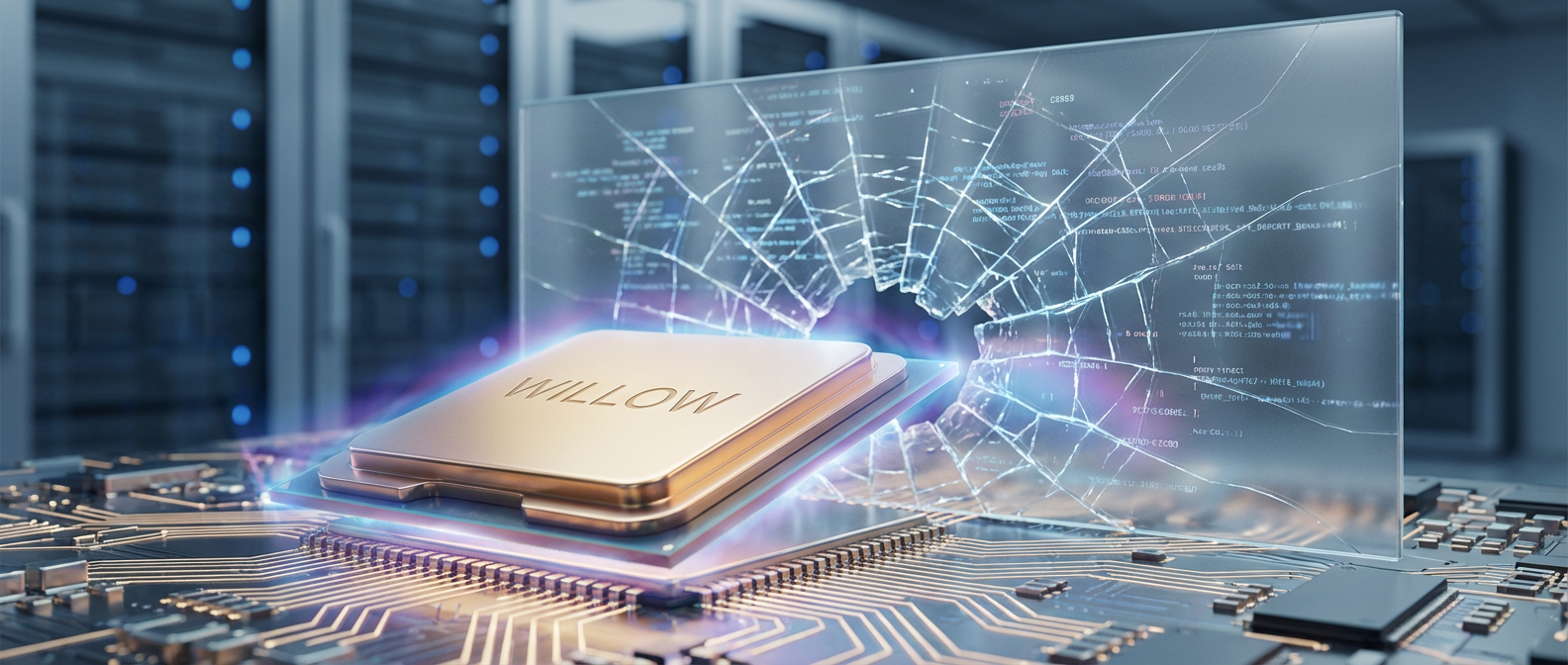
Here’s the more precise version: Willow demonstrated below-threshold error correction for the first time. That phrase doesn’t land with the same cultural impact as “10 septillion years,” but it’s the actual breakthrough worth understanding. For decades, quantum physicists have pursued a specific theoretical milestone, the point at which adding more qubits to an error-corrected system reduces rather than amplifies errors. It’s called the threshold, and Willow crossed it. That’s genuinely significant. It’s also not what your neighbor will think it means, and that distinction matters more than you’d expect.
The Overhead Problem That Willow Illuminates
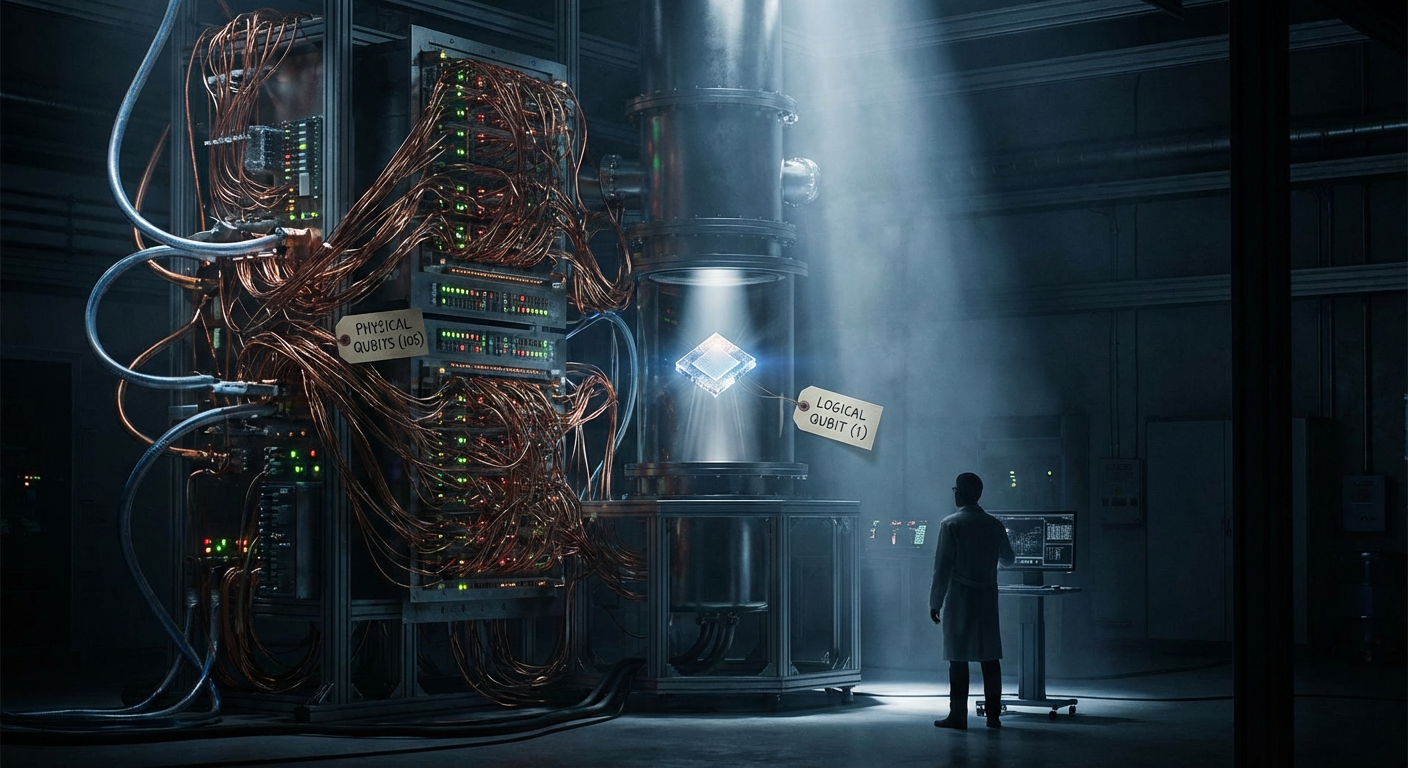
Willow operates with 105 physical qubits. Let that number sit for a moment. One hundred and five qubits sounds like a lot until you learn that this hardware achieves approximately one logical qubit of reliable computation when running in error-corrected mode. One logical qubit. The overhead ratio is roughly 100 to 1, and this represents the cutting edge of what we can do right now.
This is where the second-order thinking becomes essential. The Google Willow quantum chip announcement correctly highlights the threshold achievement, but it obscures a harder truth: we’re still in the regime where error correction is phenomenally expensive. A practical quantum computer capable of breaking RSA-2048 encryption, according to a February 2025 Nature Physics paper from the University of Chicago, would require approximately four million physical qubits under current error rates. That’s not a near-term problem to solve. That’s a civilizational engineering challenge that might take a decade or more to tackle, even with optimistic assumptions about hardware scaling.
Willow proves the physics works. It doesn’t prove we’re close to the engineering.
The Benchmark Dispute That Reveals Real Science in Motion
Google claimed that Willow performed a random circuit sampling task in under five minutes, a benchmark they argued would require ten septillion years on a classical supercomputer. IBM researchers challenged that claim in a January 2025 arXiv preprint, disputing the classical baseline assumptions underlying the calculation. This is where many observers get uncomfortable. Wasn’t Willow supposed to be the moment we moved past debate and into certainty?
Not quite. The IBM critique is substantive and worth taking seriously, but it also represents science working as intended. Google made a testable claim about classical performance. IBM examined the assumptions and found room for legitimate disagreement about what “solving” the problem actually means in classical terms. This back-and-forth doesn’t invalidate Willow’s genuine achievement on error correction. It just means we should be skeptical of the marketing velocity around quantum advantage claims. The threshold crossing is real. The ten septillion years number requires more careful interpretation.
The relevant insight: Willow’s most important contribution isn’t the benchmark performance. It’s the demonstration that error correction actually follows the theoretical predictions physicists made decades ago. The threshold exists. We’ve now observed it experimentally. Everything else in the headline is scenery.
Competing Architectures and the Error Rate Gap
Microsoft has been quietly pursuing a different approach through its Azure Quantum platform, betting on topological qubits rather than the superconducting transmon design Google uses. In early 2025, Microsoft published new error rate data showing ten to the minus fourth error rates per operation. That sounds precise until you recognize what it means: they’re still roughly 100 to 1,000 times away from the ten to the minus sixth error rate threshold needed for pharmaceutical simulation tasks, one of the most commercially attractive near-term applications.
This reveals an important structural truth about quantum computing’s current state. We’re not in a race to the finish line. We’re in a race to narrow the gap between current error rates and usable error rates. Different architectural approaches will likely succeed at different timescales. Google’s path appears ahead on the error correction front. Microsoft’s topological approach might ultimately prove more scalable, but that proof still lies ahead. The field is diversifying its bets precisely because no one yet knows which approach will dominate at scale.
Separating the Decades-Long Problem From the Years-Long One
Here’s what Willow genuinely tells us: the physics of quantum error correction is sound. We can build systems where adding qubits improves performance rather than degrading it. That’s enormous. It means the theoretical pathway forward is confirmed by experiment. We’re not chasing a mirage.
Here’s what Willow doesn’t tell us: when we’ll have quantum computers that solve practically useful problems faster than classical machines at a cost that makes sense economically. The Nature paper on quantum error correction below threshold and similar research suggests that cryptographically relevant quantum computers remain a 10 to 20 year prospect, possibly longer. Useful quantum simulation for pharmaceutical applications might come sooner, perhaps 5 to 10 years, depending on error rate improvements we haven’t yet achieved.
The second-order implication is where forward-thinking organizations should focus. We’re at the point where quantum error correction transitions from “Does it work in theory?” to “How fast can we make it work in practice?” That’s different from the question of whether quantum computers will eventually matter. They will. The question now is whether you should structure your decade around quantum advantage arriving in year three or year twelve, because the answer affects very real infrastructure decisions today.
What’s Left to Watch
The next two to three years will be defined by whether error rates continue improving at the pace these recent results suggest. Willow achieved below-threshold performance, but the “below” part is still close enough to threshold that only modest improvements push us toward the 100-qubit logical systems that start unlocking commercially valuable applications. Watch for announcements on error rate progression more carefully than announcements on qubit count. The headlines will favor the latter, but the former is what actually determines feasibility timelines.
What questions are you tracking most closely as quantum hardware development accelerates? The specific error rate targets for your domain of interest? The architectural choices different companies are making? I’m genuinely curious what the second-order implications look like from your vantage point.