The Threshold That Stopped a Decade’s Worth of Skepticism
For the better part of a decade, quantum computing research operated under a cloud of legitimate doubt. Critics weren’t wrong to ask the hard question: what if adding more qubits just made things worse? The physics community had theorized that quantum error correction should eventually flip the equation, where additional qubits would stabilize the system rather than drown it in noise. But theory and demonstrated reality are different territories.
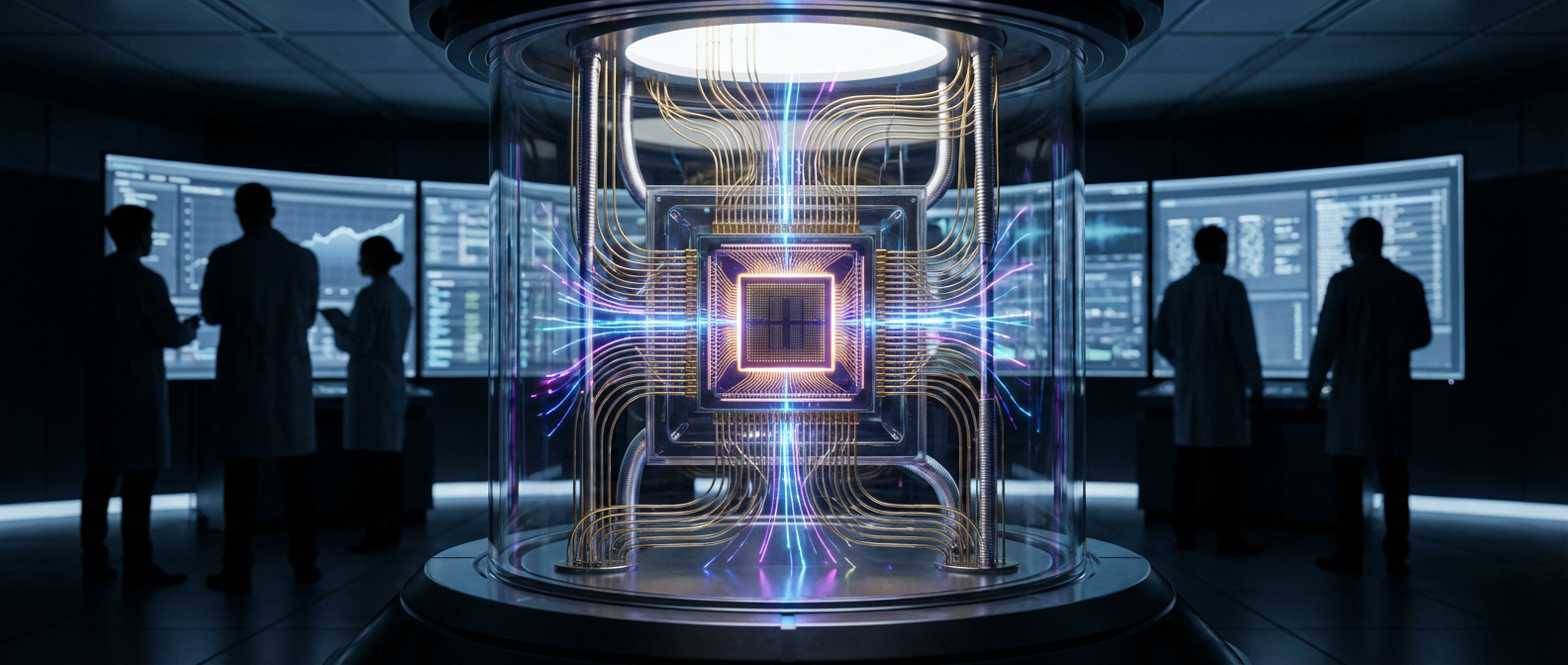
Google’s Willow chip, unveiled in December 2024, finally delivered the proof. Operating with 105 physical qubits, it achieved something the field had never cleanly demonstrated before: below-threshold error correction. For each doubling of the code distance used to protect quantum information, the team observed roughly a 2x improvement in the logical qubit error rate, precisely tracking what surface code theory predicts. This wasn’t a marginal effect or a carefully curated measurement. This was reproducible, directional improvement at scale. The implication is not subtle: we’ve entered a regime where throwing more hardware at the problem actually works.
To understand why this matters, you need to sit with what came before. Earlier quantum systems existed in a frustrating middle ground: powerful enough to be interesting, too noisy to be reliable. Every qubit you added introduced fresh error pathways. Researchers could suppress errors in small systems, but the approach didn’t scale. Willow changes that calculus fundamentally. The error rate improvement aligns with theoretical predictions, which means we can now trust the roadmaps that extrapolate from this point forward.

The Benchmark Nobody Expected to See This Soon
Before getting swept up in the implications, let’s ground ourselves in what Willow actually did. The chip completed a random circuit sampling benchmark in under 5 minutes. Google’s analysis suggests the same calculation would demand roughly 10 septillion years on the world’s fastest classical supercomputer. That’s 10 followed by 24 zeros. The number is so absurd it almost obscures what’s genuinely significant about the achievement.
The problem with quantum benchmarking is that it can slide easily into marketing theater. Random circuit sampling is somewhat artificial. It’s not factoring large numbers or simulating molecular systems or solving optimization problems that anyone actually cares about in a practical sense. But that’s precisely why it’s the right benchmark at this stage. It’s a clean, reproducible task that demonstrates quantum advantage without requiring us to have already solved the harder problems of encoding useful calculations into quantum algorithms. Think of it as a speedometer test rather than proof that you can drive across the country.
What genuinely caught attention in the Google Willow Quantum Chip – Nature Paper was the consistency. The results published in Nature in December 2024 showed that the system behaved exactly as theory predicted. That sounds boring until you realize it means we can now build roadmaps with confidence. When your experimental results align with your theoretical models, you can start asking second-order questions with real answers. How long until we get 1,000 logical qubits? What does the error rate curve tell us about timelines for fault-tolerant quantum computing?
Timelines Just Compressed, and Nobody’s Sure What That Means
IBM, one of Google’s primary competitors in quantum hardware, currently targets achieving fault-tolerant quantum computing through a roadmap calling for 100,000 physical qubits by 2033. That’s a concrete public commitment. When Willow demonstrated that error correction could improve with scale, using just 105 qubits, it raised an uncomfortable question for everyone in the industry: does that timeline need to move forward?
This distinction matters enormously. Willow proved that the error correction principle works. It did not prove that we can build a fully fault-tolerant quantum computer tomorrow. The gap between demonstrating a principle and engineering a practical system is often where years of hard work happen. But the principle working on this timescale, with this consistency, changes what “possible by 2030” means versus “possible by 2028” versus “possible by 2026.” When someone shows you the physics works at scale, every engineering challenge becomes a matter of engineering rather than a question mark about fundamental viability.
This creates a peculiar pressure in the quantum space. Roadmaps that looked conservative suddenly look like they might be over-provisioned. Companies and national governments that committed to specific qubit counts and delivery dates need to recalibrate. The race dynamics shift from “will this work” to “when will this work, and who gets there first.” That’s a different competitive environment entirely, and it accelerates investment and focus.
The Cryptography Emergency That Nobody Talks About Enough
Here’s where the second-order thinking gets unavoidable. In August 2024, NIST finalized its first three NIST Post-Quantum Cryptography Standards, specifically because the threat of quantum computers breaking RSA-2048 encryption had moved from theoretical to credible. That wasn’t an abstract precaution. It was a direct acknowledgment that the timeline for cryptographically relevant quantum computers had compressed enough that defensive action was necessary now, not in some distant future.
Willow doesn’t change the timeline for breaking RSA directly. Current quantum algorithms that threaten RSA encryption would still require millions of stable logical qubits, not dozens. But demonstrating that error correction works as predicted means someone can now model with confidence what achieving a million stable qubits looks like. If the roadmap says 100,000 physical qubits gets you to fault tolerance, and error correction improves predictably, then a path to cryptographically relevant quantum computing becomes visible rather than speculative. Organizations holding encrypted data that must remain secret for 30 years can no longer treat post-quantum cryptography as optional.
The cryptography standards from NIST aren’t sexy. They’re not going to trend on social media. But they represent a genuine shift in how governments and institutions are treating quantum computing risk. This shift happened because the gap between “theoretically possible” and “practically achievable” shrank just enough to require serious contingency planning.
What Comes Next: The Unsexy Hard Part
Quantum computing hype tends to pulse with major announcements followed by deflating silences. Willow will be no different. The press coverage will fade. Someone will find a minor limitation and write a contrarian article. The field will return to the grinding work of actually building something useful.
That grinding work is where the real timeline questions get answered. Can the error correction approach scale to hundreds of qubits, then thousands, without introducing new failure modes? Can qubit quality improve fast enough to keep pace with increased complexity? Can the cryogenic infrastructure and control electronics be manufactured reliably at scale? These are no longer physics questions. They’re engineering questions, which means they have deterministic answers.
What Willow gave us wasn’t a finished product or a clear path to one. What it gave us was permission to stop hedging. We can now say with evidence-based confidence that quantum error correction works as the theory predicts. Everything that follows from that fact is still uncertain, but it’s uncertain in productive ways. We can measure progress. We can build timelines. We can make investment decisions with better information.
If you’ve been watching quantum computing from the outside, waiting for some moment when it stopped being speculative and started being inevitable, this might be it. Not because we have quantum computers yet, but because we finally demonstrated the critical principle that makes them possible. What do you think the next major milestone should be? I’d be curious what timeline changes you’d predict if you had to commit to an answer.