The Great Ocean Misconception
Ask someone what humanity knows less about than the surface of Mars, and many will confidently answer “the deep ocean.” This comparison, while catchy, shows a fundamental misunderstanding about both planetary exploration and marine science. The reality is more complex and way more interesting than this oversimplified soundbite suggests.
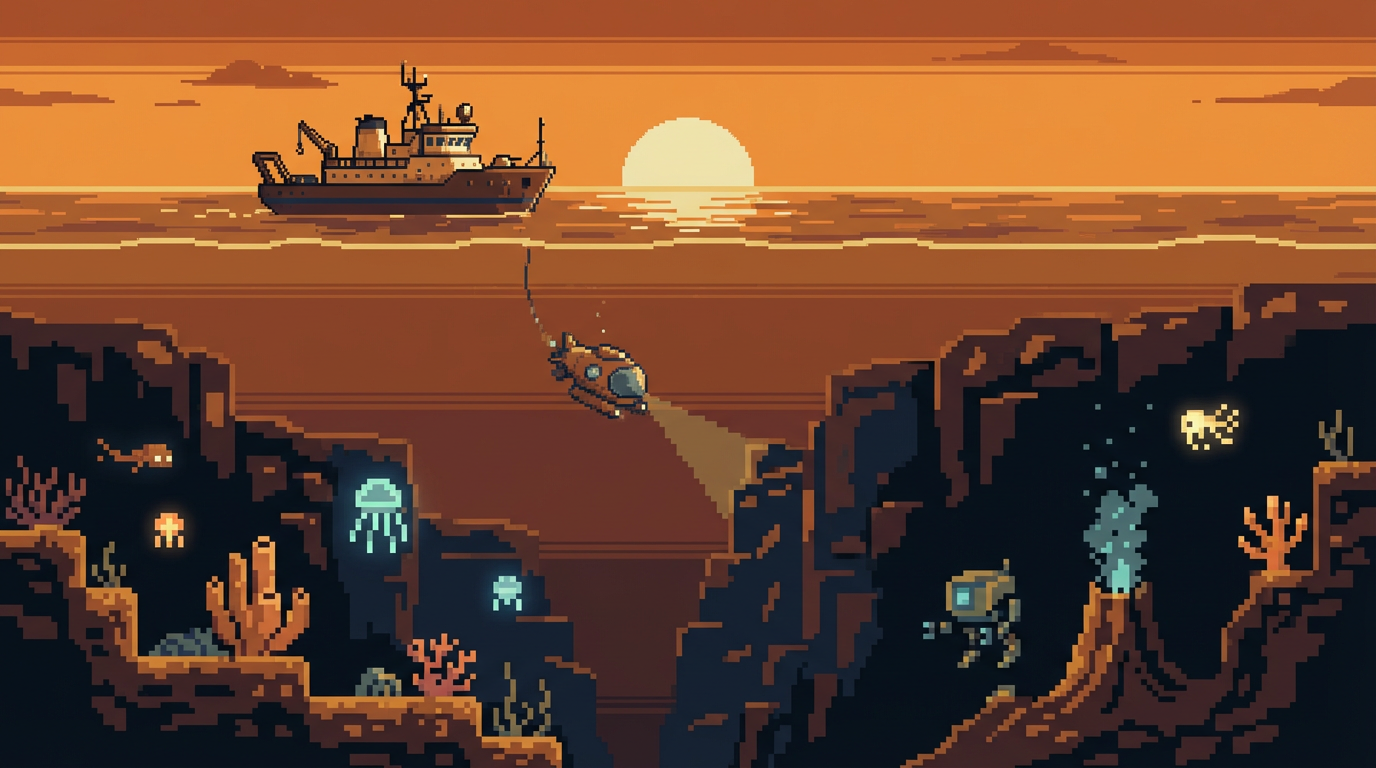
The myth sticks around because we mix up different types of knowledge. Sure, we’ve mapped Mars at resolutions that show features as small as a few meters across. And yes, roughly four-fifths of Earth’s seafloor remains unmapped at comparable detail. But this single metric hides the huge differences between photographing a barren planetary surface from orbit and understanding the complex, living ecosystems that thrive in Earth’s deep waters.
What makes this misconception so persistent is its grain of truth wrapped in misleading packaging. Mars exploration captures public imagination precisely because it is the unknown frontier of space. Meanwhile, the ocean feels familiar. Something we swim in during summer vacations. This false familiarity makes us complacent about what lies beneath the waves, making the Mars comparison feel both shocking and memorable.

The Hidden Universe Beneath the Waves
The scope of oceanic biodiversity challenges our land-focused perspective on life itself. Marine researchers consistently discover approximately 2,000 new species each year through deep ocean surveys, a rate that suggests millions of organisms remain scientifically unknown. These aren’t just minor variations on familiar themes, but entirely new evolutionary solutions to extreme environmental pressures.
Consider the organisms thriving around hydrothermal vents, where crushing pressure and temperatures exceeding 400 degrees Celsius create conditions more alien than anything we might encounter on Mars. MBARI ocean research has revealed ecosystems operating on chemosynthesis rather than photosynthesis, fundamentally rewriting our understanding of how life can persist without solar energy.
The deep ocean also houses Earth’s largest habitat for complex life. While Mars may offer tantalizing hints of ancient microbial activity, the abyssal plains teem with sophisticated organisms that have evolved complex behaviors, communication systems, and ecological relationships over hundreds of millions of years. Giant tube worms, bioluminescent jellies, and deep-sea coral gardens represent evolutionary achievements that dwarf anything we might hope to find in Martian soil samples.
Environmental Pressures Reshaping Ocean Chemistry
The ocean’s role as a planetary life support system faces unprecedented challenges that demand immediate scientific attention. Ocean acidification now proceeds at the fastest rate documented in 300 million years of paleoclimate records, fundamentally altering seawater chemistry faster than marine organisms can adapt. This is a real-time planetary experiment with consequences that will ripple through marine food webs for centuries.
Perhaps most sobering is how far human influence has penetrated even the most remote ocean depths. Recent surveys have documented plastic pollution in the Mariana Trench at depths exceeding 11 kilometers, proving that no corner of our planet remains untouched by industrial activity. These findings shatter romantic notions of the deep sea as pristine wilderness, revealing instead an ecosystem already bearing the chemical signatures of human civilization.
The urgency extends beyond pollution to resource extraction. Deep sea mining proposals alarm marine biologists who recognize that we face the prospect of industrializing ecosystems we barely understand. Unlike terrestrial mining, which affects relatively well-studied environments, deep sea extraction threatens to destroy habitats that may have remained stable for millions of years, potentially erasing species before science even discovers them.
Technological Revolution in Ocean Exploration
Recent advances in autonomous underwater vehicles are revolutionizing both the speed and cost-effectiveness of deep ocean research. These robotic explorers can spend months surveying remote areas that previously required expensive human-operated submersibles, democratizing access to the deep sea for research institutions worldwide.
Modern AUVs equipped with high-resolution cameras, chemical sensors, and specimen collection systems generate unprecedented datasets about deep ocean conditions. They can map seafloor topography while simultaneously analyzing water chemistry, documenting wildlife behavior, and collecting genetic samples for later analysis. This technological leap means that discoveries once requiring decades of preparation can now happen in real-time during extended robotic missions.
NOAA Ocean Service coordinates many of these technological deployments, ensuring that data collection helps both pure scientific research and practical applications like fisheries management and climate monitoring. The integration of satellite communication systems allows researchers to adjust mission parameters remotely, responding to unexpected discoveries without waiting for vehicles to return to port.
Reframing Our Planetary Perspective
Understanding Earth’s oceans requires abandoning the Mars comparison entirely and embracing a more sophisticated appreciation for different types of knowledge. While we may have higher-resolution maps of Martian crater formations, we possess vastly more detailed understanding of oceanic chemistry, biology, and physics than we do of any extraterrestrial environment.
The real revelation lies in recognizing how ocean science integrates multiple disciplines in ways that space exploration cannot yet match. Marine research simultaneously advances our understanding of climate systems, evolutionary biology, biochemistry, geology, and ecosystem dynamics. Each deep sea expedition generates insights that reverberate across dozens of scientific fields.
This interconnectedness makes ocean science particularly valuable for addressing contemporary environmental challenges. Climate change, biodiversity loss, and pollution represent interconnected problems that require the kind of systems thinking that ocean research naturally develops. The deep sea acts as both an early warning system for planetary changes and a laboratory for understanding how complex ecosystems respond to environmental stress.
Rather than perpetuating tired comparisons between planetary exploration and marine science, we might better appreciate how each domain of knowledge contributes to humanity’s understanding of life in the universe. The next time someone mentions that we know more about Mars than our own oceans, consider sharing what recent deep sea research has actually revealed about the extraordinary world beneath the waves.